 Folk ritual
Da Siu Yan: the Hong Kong villain-hitting ritual, on your iPhone.
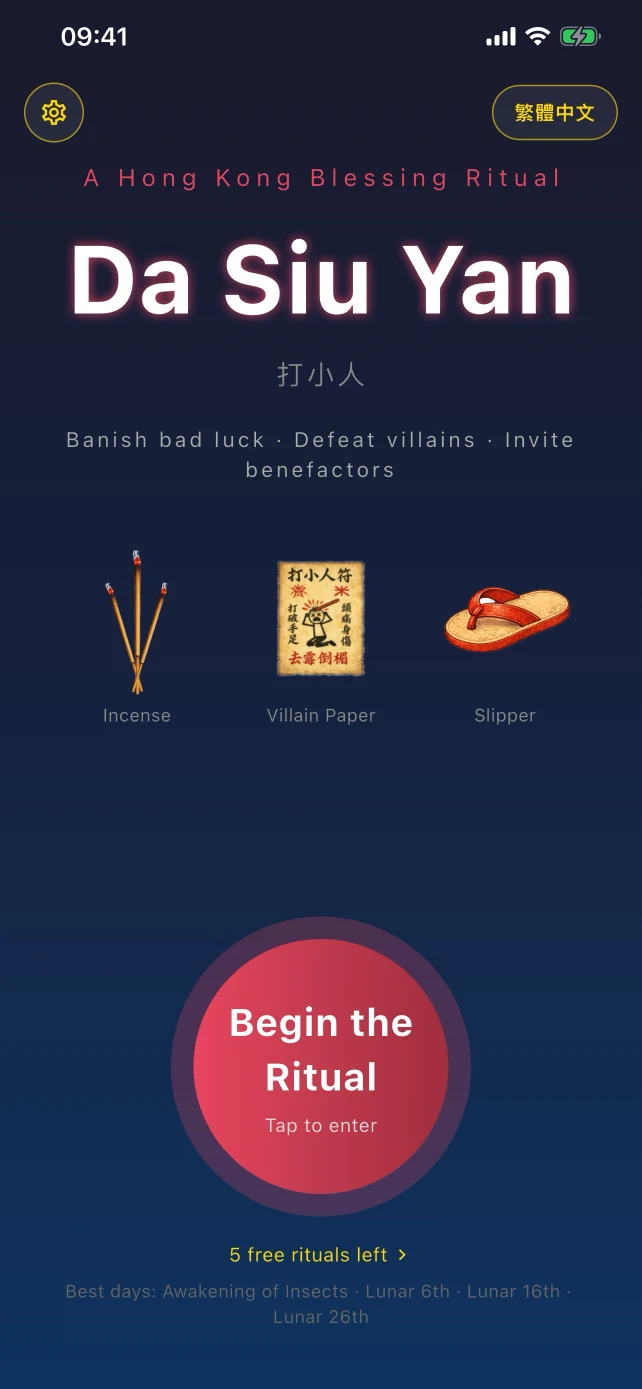
Under Canal Road's Goose Neck Bridge, ritual masters have beaten paper effigies with slippers for a hundred years — driving petty people out and inviting noble benefactors in. Da Siu Yan puts the complete eight-step ceremony in your pocket: name your villain, beat the effigy to shreds, feed it to the White Tiger, and seal it all with a cast of the moon blocks. Paper-craft folk art, bespoke sound, fully offline, no ads.
Why Da Siu Yan
The full 8-step ritual
Incense offering, declaration, twenty slipper strikes, the White Tiger, dispelling, blessing, treasure burning, and a closing cast of the moon blocks — the order faithfully follows folklore.
Paper-craft folk art
Every step has its own bespoke animation and sound, drawn in a paper-craft style that honours the street-side original.
Private by design
Names written on the villain paper never leave your iPhone — nothing is uploaded, nothing is stored, and closing the ritual clears it all. No account, ever.
Offline, no ads
Hold a ceremony anywhere — the MTR, a lunch break, a long queue. The app works fully offline and shows no advertising.
Villain paper and nobleman paper
Name the petty person on the effigy, then write your own name on the nobleman paper to invite benefactors in — both halves of the custom are here.
Five rituals free
Your first five complete rituals are free. Afterwards, top up credits per ritual — consumable, no subscription.
The custom
A hundred years under Goose Neck Bridge.
Villain hitting — da siu yan (打小人) — is one of Hong Kong's most distinctive folk customs. On Jingzhe, the Awakening of Insects, crowds gather under Canal Road's Goose Neck Bridge in Causeway Bay, where ritual masters beat paper effigies with old slippers while chanting, driving the "petty people" — schemers, backstabbers, bad luck — out of a client's life. The ceremony ends with blessings on a nobleman paper and a cast of crescent-shaped moon blocks.
What began as folk religion has become something Hongkongers treat with affectionate practicality: part heritage, part therapy. It is listed as part of Hong Kong's intangible cultural heritage, and the bridge-side masters remain a living tourist landmark.
The app
The ceremony, faithfully digitized.
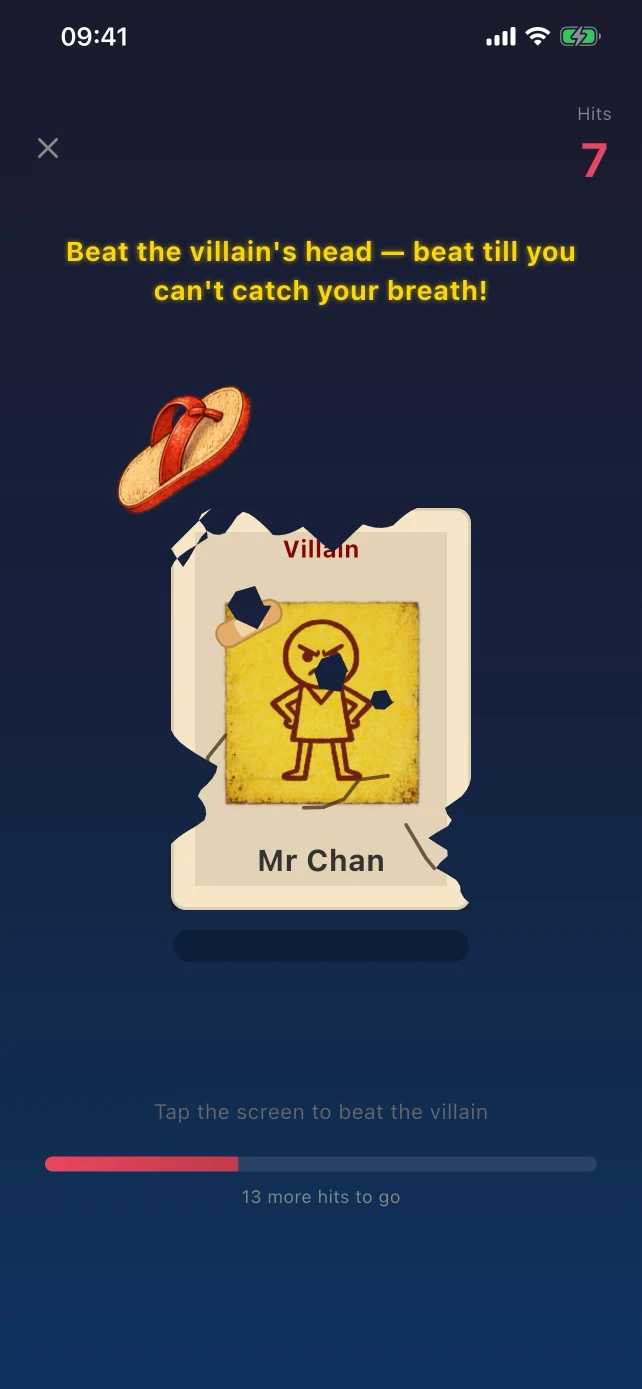
Da Siu Yan follows the traditional order step for step. You name your villain on the paper effigy — male, female or generic — then beat it: twenty slipper strikes, the paper visibly shredding as you go. You seal the White Tiger's mouth with pork and feed it the battered effigy, scatter sesame and mung beans to dispel bad luck, write your name on the nobleman paper for blessings, burn treasure paper, and cast the moon blocks — a sacred pair seals the ritual.
Because it runs entirely offline and on-device, the ritual stays as private as the real thing. No account, no ads, no upload — and the name you wrote disappears with the ceremony. And for anyone searching for villain hitting online because a trip to Canal Road is not on the cards: this is the whole ceremony, faithfully, on your phone.
Petty people out, benefactors in.
Whether work is going sideways, someone is scheming behind your back, or it is Jingzhe season — have a session and feel the weight lift. Your first five rituals are free.
Download on the App StoreFAQ
Questions, answered.
What is villain hitting?
Villain hitting (打小人, da siu yan) is a century-old Hong Kong folk custom. Under Canal Road's Goose Neck Bridge in Causeway Bay, ritual masters write the name of a "petty person" — a schemer, a backstabber, a source of bad luck — on a paper effigy and beat it with a slipper, then invite noble benefactors in. It is part folklore, part stress relief, and a recognized piece of Hong Kong's intangible cultural heritage.
Is Da Siu Yan free?
Your first five complete rituals are free — the full eight-step ceremony, no watermark on the experience. After that, you top up credits per ritual. There are no ads and no subscription, ever.
Does it work offline? Is my villain's name stored anywhere?
Yes and no — in the good ways. The whole ceremony runs offline, and any name you write on the villain paper is processed only on your iPhone: never uploaded, never stored on a server, and cleared from memory when the ritual closes. There is no account at all.
What are the eight steps?
Incense Offering, Declaration (naming your villain), Villain Beating (twenty slipper strikes that shred the effigy), White Tiger (seal its mouth with pork, then feed it the effigy), Dispelling (scatter sesame and mung beans), Blessing (write your name on the nobleman paper), Treasure Burning, and Block Casting — cast the moon blocks, and a sacred pair seals the ritual.
Does it actually curse anyone?
No — and it never did. Villain hitting is symbolic folklore: a way to blow off steam and mark a fresh start, the way Hongkongers have done for a hundred years. Think of it as a cultural ritual for your own peace of mind, not an act upon anyone else.
Which languages and devices?
The app runs in English and Traditional Chinese, on iPhone (iOS). The best days are traditional ones — Jingzhe (Awakening of Insects), or the 6th, 16th and 26th of the lunar month — but the bridge is always open.
More from Twelvefold
Tools that pair well with this one.
 CrafteeRound corners & AI cutout for iPhone
 LatentPrivate AI image generator
 TalkaAI English speaking coach
 OverLensOn-device screen translator
 QRacadeAnimated QR code generator
 SoarlyticsPublic X (Twitter) stats
 NYC HustleRetro pixel trading game
 WHEEFree browser mini games